Comfort/Security, Freedom/Experience or The Myth of White Universality
Prompt No. 71: Botox, Benjamin, Blackness (TW: Suicide)
The title is taken from a comparison Alice Walker presents in her essay,
“Saving the Life That Is Your Own: The Importance of Models In the Artist’s Life.”
The plan was to write about ugliness, to discuss the importance of visual discordance in presentation under technocratic fascism. I wanted to explain how algorithmic media has transformed beauty from specialized knowledge to uncultured uniformity, and that that transformation has yielded hideous results. How current techniques of the body we are meant to adopt are more permanent means of objectification. We’ve gone beyond big brows and the right (or wrong) millimeter lashes to observable bones, Botox, bloated lips, and bulky veneers. Fashionable beauty increasingly strips the wearer of humanness, making exploitation easier to accept. And that is the goal of white supremacist capitalist patriarchy. But how many times can I make this point? By the second paragraph I was bored. Whiteness is boring. It exists to standardize life in ways that distract us from desiring anything outside its prescribed social patterns. That standardization exalts rationality and extinguishes emotion that, in exchange for its adoption, allows some to enjoy a level of comfort that still looks an awful lot like inequality. We see it every time a white woman racks up views publicizing and justifying their husband’s misogyny or an Asian or Latin American spews anti-Black rhetoric only to be told to go back to their country in comments. However, Black folks have a wonderful little phrase I found myself uttering before I deleted the draft: They like it, I love it. Even critiquing the absurdity of it all still centers it and keeps me from pursuing far more interesting ideas, like Brutalism as a personal aesthetic philosophy to catalyze radical change or how fashion theory can fully engage with Black American thought. This does not mean a total rejection of Western ideology, but rather refusing its universality.
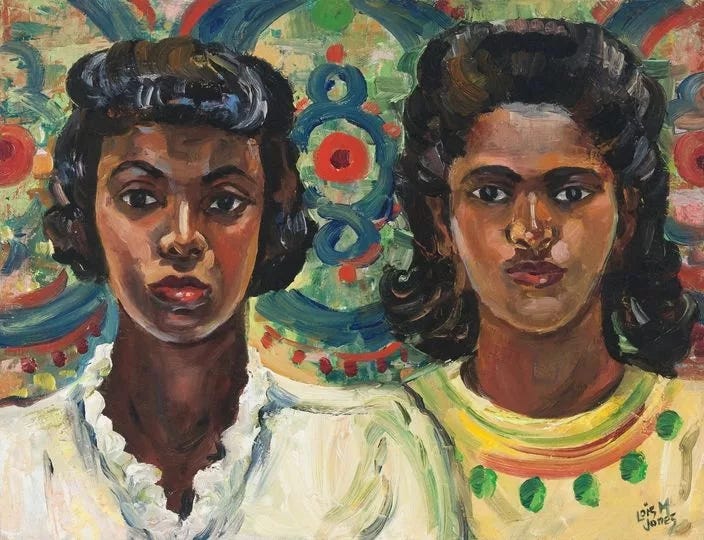
It’s actually easy to do when you’re a Black woman. What standards apply to us when we are supposedly so ugly, unkind, unwanted, uneducated, and unaffluent? To exist outside the confines is a sort of freedom; one I could not help but think of the other day as a white woman told me in hushed tones that she would not have had kids had she adopted a dog first. Aware of society’s expectations of her then and now, she softened the admission by clarifying that she did not regret having children before trailing off, unsure of where to go next with the thought. This was not a universal predicament, but only one of us cared to understand that. America hates Black mothers and children, so Black women created a different world in plain sight. I grew up in it with a mother who read Alice Walker, Octavia Butler, Zora Neale Hurston, Toni Morrison, Tananarive Due, and my favorite Ntozake Shange. A mother who sparred with friends over current events, arguing her point without ever wounding or souring spirits. A mother who constantly reminded me to only get an education at those white schools because we proudly had our own way of doing things. In that world, I had no choice but the imagine the biggest life possible because Black womanhood looked so limitless, rich, and vibrant. While white folks had no expectations of me, my mother had only one: to be the best Jesica I could be. It was up to me to define that and I did so early on, choosing an unmarried, child-free life. Obviously, that white woman did not grow up with that freedom. That’s the difference between fashioning identity from culture versus the cankers of colonization. But if she was shackled, certainly I was too.
Walter Benjamin, a key fashion theorist, made a similar mistake in the early 1930s, claiming that experience had fallen in value, introducing “ a completely new poverty” that threatened civilization:
“For what is the value of all culture if it is divorced from experience? Where it all leads when that experience is simulated or obtained by underhanded means is something that has become clear to us from the horrific mishmash of styles and ideologies produced during the last century — too clear for us to no think it a matter of honesty to declare our bankruptcy. Indeed (let’s admit it), our poverty of experience is not merely poverty on the personal level, but poverty of human experience in general.”
This was not — and still isn’t — a universal truth, but I’ll get back to that. Concerned with humanity’s ability to survive this poverty, Benjamin suggested barbarism as the solution: “For what does poverty of experience do for the barbarian? It forces him to start from scratch; to make a new start; to make a little go a long way; to begin with a little and build up further, looking neither left nor right.” According to Benjamin, beginning again, so to speak, did not mean renovating language, but “changing reality instead of describing it.” As the world’s “barbarian”, Black people have done just that, surviving for ages off experience; encrypting it in sermon, story, song, and dance. It is the foundation of Black Aesthetics. Surely Benjamin knew this, but as Marimba Ani said, “With writing comes control, and with control, for Europeans, comes power.” As such, Black Aesthetics became modernism — experimentation, abstraction, and subjectivity — and Benjamin is credited as its father. Of course, the Harlem Renaissance and its philosophical architect, Alain Locke, predated all of this by nearly a decade. Not only is whiteness boring, it’s behind.
But back to me. The day after my conversation with the white woman, I reread Alice Walker’s essay “Saving the Life That Is Your Own: The Importance of Models In The Artist’s Life” and saw it anew. In it, Walker recounts being asked the difference between literature written by Black and white writers, and explains that:
“White American writers tended to end their books and their characters’ lives as if there were no better existence for which to struggle. The gloom of defeat is thick. By comparison, black writers seem always involved in a moral and/or physical struggle, the result of which is expected to be some kind of larger freedom.”
To illustrate this point, she compares The Awakening by Kate Chopin and Their Eyes Were Watching God by Zora Neale Hurston, pointing out several similarities between Chopin’s Mme Pontellier and Hurston’s Janie Crawford. “Each woman is married to a dull, society-conscious husband and living in a dull, propriety-conscious community. Each woman desires a life of her own and a man who loves her and makes her feel alive. Each woman finds such a man.” But while Mme Pontellier kills herself rather than defy society’s standards and expectations, Crawford takes a very different approach, which Walker describes in a poem she later wrote:
I love the way Janie Crawford
left her husbands
the one who wanted to change her
into a mule
and the other who tried to interest her
in being a queen.
A woman, unless she submits,
is neither a mule
nor a queen
though like a mule she may suffer
and like a queen pace the floor.
Even with the (rare) promise of comfort, Janie recognized it as a false reality. The next day, I rewatched Black Girl by Ousmane Sembène and, as I have countless times before, felt a grin stretch across my face as the main character, Diouanna, kicks off her heels in the middle of her Madame’s apartment when told not to forget she’s a maid. Though that may be her title, it is not Diouanna’s status. She knows she’s seen as a slave, but instead of leaving, she slits her wrists in the bathtub she’s tasked with cleaning. Her death is an act of defiance, not cowardice. Despite taking place in 1960s Senegal and France, Black Girl mirrors the narrative of countless enslaved Black women centuries earlier who not only asserted their humanness any number of ways, but liberated themselves when it went ignored. Walker was right. We were never meant to be free, and yet we have always found a way to imagine, fight for, and experience it. Or as we’d say, make a way out of no way.
Now that I think about it, the most recent sermon my mom gave me — weeks before all of this — was on boredom. She did not mean within the work of dead white men. Quite the contrary, I needed to meditate, watch the birds, stare at the clouds. Step away from all of this. Yet, that’s where I seem to have found it. There is no imagination, no creativity, no progress, no truth in whiteness; therefore, I will never know freedom in describing their chains. It’s time to change reality and approach fashion theory differently.