Some Ways of Seeing
Prompt No. 71: Nag Champa, Meshell Ndegeocello, and Other Acquisitions
Lately, I find myself reflecting on the paucity of my early twenties. I was working as an editor then, making no money, and living in a wonderfully old apartment building. A mattress sat on the bedroom floor with a small brass Moroccan table beside it. My grandmother’s alabaster lamp lit the room just enough to read at night. The living room had a makeshift shelf, a replica of a set up my mother designed for a room I let for a summer a few years earlier. A piece of plywood and a couple of cinderblocks held a tube television, a box of Nag Champa incense and an old brass candlestick I took from home. Books lined the walls. A couple of ladder-back chairs with corded seats accompanied a fold-down kitchen table, and every so many weeks I replaced a bar of Dudu Osun in the bathroom.
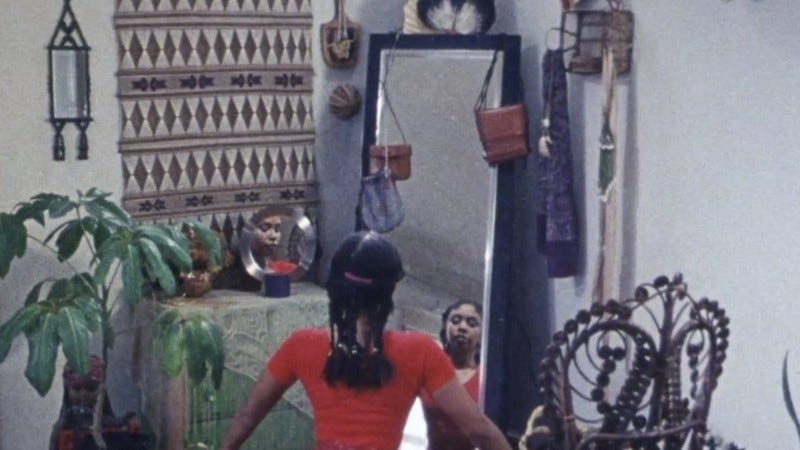
Although I had a 1992 Jeep Cherokee, I walked to work to avoid losing my parking spot. There were no complicated coffee orders to place in the mornings, no trendy luxury totes to performatively stuff and adorn. I carried a wallet, an iPod, and a book, and if I had a few extra bucks, I might order a tea or a bowl of soup from the cafe next door and read during my lunch hour. I obviously did not need much and do not recall wanting for more than what I had. And I think that had a lot to do with the Black Aesthetics that shaped my perspective to that point. Writers, artists, and filmmakers of the 1960s, ‘70s, and early ‘80s committed to defining Black life on its own terms, as a means of liberation, producing works that rejected white capitalist oppression. I was heavily influenced by image of the Black woman artist in She’s Gotta Have It and A Different Image, eager to channel either the serenity of Giovanni or the blaze of Baraka. And after I have gotten lost in memory, I wonder what it would take to get back there now. Not to the simplicity — that’s easy enough — but the philosophy. Because it is not Saint Heron glassware or secondhand Hanifa knits…
But I am getting ahead of myself. Here we acquire perspective, not just things, and honestly, writing about whiteness and Western beauty over the last few weeks stressed me out (hence the reflections on Black Aesthetics). It is hard to witness a detrimental cycle in progress, one with no benefit. That said, the stress has left me wondering what is beauty? To answer it, I have flung myself back into the arms of ugliness. According to German philosopher Karl Rosenkranz, who wrote Ästhetik des Häßlichen (Aesthetics of Ugliness), beauty is unity, “a sensible appearance of an idea” that “gives us a whole that refers to itself.” Of course, I do not trust this definition entirely. Colonial racism certainly informed Rosenkranz’s work, begging the question who gets to define “sensible” or determine which ideas are presented.
Anyway, these are just some of the thoughts floating in my head at the moment that I hope result in a coherent post in a couple of weeks. To soothe myself, I have been listening to The Maxim, a 10-minute meditation on time by Tom Skinner featuring Meshell Ndegeocello. I am not even sure what to say about this other than two jazz geniuses came together to craft perfection. If you aren’t familiar, I highly recommend checking out anything by either artist, but I have a soft spot for Ndegeocello’s 2007 release, The World Has Made Me The Man Of My Dreams and Skinner’s 2022 EP, Voices of Bishara.
Watch.
Ways of Seeing by John Berger
Years ago, my friend Sophie Nunberg recommended I read Ways of Seeing by John Berger, but unwilling to wait a few days for the book to arrive, I binged the BBC docuseries on YouTube later that day. If you have not watched it, it is well worth the time, if for no other reason than to really understand the evolution of how we understand images and symbols. It is particularly useful viewing for anyone interested in Roland Barthes and the semiotics of fashion.
Honorable mention: If you have another hour to throw at the topic, I highly recommend following this up with Berger’s 1983 discussion with Susan Sontag on telling stories. Fashion, style, and presentation are all tools we use to tell a story of ourselves, therefore I think it is really interesting to not only investigate how we are influenced to utilize those tools, but how whether we utilize them successfully.
Read.
When No One Looks Their Age, What Happens to Aging? (Cosmopolitan)
I read two interesting pieces on techniques of the body this week. One on Cynthia Erivo’s experience inside “the ‘Wicked’ machine” and another on what happens when no one looks their age. In an interview with Variety, Erivo reflected on the challenges that came with promoting “Wicked” alongside her friend and co-star Ariana Grande. As I mentioned in the previous edition, both were lauded for their extreme thinness on darker corners of the Internet, but Erivo was also criticized and mocked for constantly protecting and tending to Grande. (If you somehow missed it, The Root broke down the complex nature of this hyper-attentiveness.) Interestingly, Erivo, who has made disparaging remarks about Black Americans in the past, said, “I think we haven’t really come to terms with the insidious nature of how we view Black women… Because that’s what was being made fun of. It was my physique; it was my shape; it was the fact that I was bald; it was about what I looked like. And because of that, there was this assumption that I was bigger than my co-star and so I had to be controlling or protecting, and that was my role. I would hazard a guess that it would not have been the same had it been the other way around.” But that’s just it. It wouldn’t be the other way around. We don’t have many examples of white women stepping in and protecting Black women, physically or emotionally. (As a matter of fact, many are witnessing this lack of reciprocity right now on Bravo’s Summer House.) While Erivo is right that race shapes the way her behavior is perceived, it’s obvious that even she has not really come to terms with the way in which Black women are viewed. Assuming there could even be an “other way around” is a loud admission of ignorance on her part. Then there’s the question of “age blindness” now that a few [white] women under 50 haven’t turned into old hags yet. Apparently, Anne Hathaway (43) and Margot Robbie (35) look good and that’s throwing everyone into a tizzy. Despite my tone, this was a decent read on the increasing amount of work women undergo to maintain fashionable beauty. However, I would have liked some acknowledgement that 43 — or, hell, 35! — is hardly old. Then again, I am Black, so perhaps I am no-account.
Speaking of being Black, my windows are open and yet there is not a stick of incense burning. Allow me to rectify that. Have a wonderful week, friends!