The Beauty of Brutal Aesthetics
Prompt No. 66: Aura, Avant Garde Animation, and Acquisitions
I have mentioned the uniform I relied on to get through 2025 — a gray threadbare sweatshirt, white single stitch tee, and a pair of 505s almost as old as I am — but I have not mentioned the ring; an open, modernist piece in brass that I bought in the midst of everything. Looking back, I cannot recall what prompted the purchase or even the shift toward something so unconventional, but I wore it constantly, growing fonder of its biomorphic beauty with each wear. Later, when I began stuffing the contents of my closet into boxes and bags, I started to look for a similar piece in silver. The search prompted a realization: I wanted to strip away any warmth and ease. I needed to feel cold. Brutal. That is a loaded word on its own, but for those familiar with fashion theory or the history of aesthetic movements, it’s almost too accurate a description. At the end of a challenging year, I not only felt raw, but moved to reconstruct my presentation in a way that exposed that truth. Europe underwent a similar transformation following World War II with architects erecting structures that were as raw and simple as possible. The U.S. followed suit a decade or so later. It seemed I had moved into my Brutalist era.
Interestingly, I grew up rather averse to Brutalism. Having an opinion on the architecture style from a very early age is a particular quirk of growing up in D.C. where the architecture style is fairly common. Its shadows tend to ensconce smokers and house the homeless. Its walls weep in the rain. Everything in the vicinity of these buildings radiate a scalding heat that make the city even hotter in the summer. I did not shake my disdain for these formidable fortresses until I understood they reflected simplicity, modernity, and new ideas. However, I became a staunch supporter once President Trump declared war on them on his first day back with a memorandum that called for the respect of “classical architectural heritage” — not out of reflex, but because it foreshadowed his commitment to ignorance and ruthlessness in his second term. As one architect put it, “If modernism is about architecture being honest, then Brutalist design is about architecture being brutally honest.” Modernism and Brutalism not only oppose the ornamental façade of civilization, but, as (Marxist) philosopher Walter Benjamin stated, teach us how to survive it “if need be.” To align my presentation with this style philosophy may seem like a singular experience, but it’s not. There are no new experiences or emotions. Brutal aesthetics has long held the answer to fashion’s commodity fetish, or “the endless chain of goods that we desire and then relinquish for another object of desire to be purchased.”[1] Still, even when life’s wrung this desire from your bones, you still need to get dressed. By adopting a brutalist philosophy, or one that considers what’s “the most basic and the most brutal”, I have begun to construct an anti-fashion wardrobe.
According to Adam Geczy and Vicki Karaminas, who have situated Benjamin’s work within fashion theory, “Anti-fashion can be best defined as oppositional dress, an umbrella term that is bandied by designers and the fashion industry to describe dress styles that are contrary to the fashion of the present.” While this may literally mean hand-painted coats from Stovaigh instead of macrame aprons from Miu Miu, it also means an awareness of fashion’s inherent violence and decay. In order for fashion to exist, it must make itself unstable; reflecting the past within the present, as well as a future it has to anticipate. This temporal nature does not reflect our actual social condition, rather it establishes “false realities” required for capitalism to thrive. Geczy and Karaminas explain:
“With fashion, the bourgeoisie can play out its false consciousness, and seek consolation in novelty, to the exclusion of the real signs of utility… the transformation of clothing to fashion enacts a violence on this kind of aesthetic utility since it debases beauty, attraction, allure, and aura to base integers of arbitrary vanity, whose qualities are exploited since fashionable beauty must die to make way for what comes next.”
Therefore, anti-fashion is persistent; it holds the ability to withstand time and also reflect that time back to us.
In January, I found my ring — a silver modernist ring my mom described as “a little ugly.” It’s clearly vintage and handmade, an inch-long amoeba of highly polished metal someone looped and let puddle in places until they were satisfied with the overall effect. It set the tone for this reconstruction, inspiring me to see how raw, how formidable, how “ugly” I can get. This is how I plan to survive.

But here we acquire perspective, not just things and I have been chasing the high of complete aesthetic alignment. You know the feeling of experiencing someone’s creative output as though it expressed thoughts and emotions you have yet to fully process? How it transports you to another dimension, but only for as long as you can witness it? I felt that a couple weeks ago and have since felt unhinged trying to recapture the sentiment.
But before I get to that, check out Into the Doldrums the 2025 release from Now Always Fades. The triphop-tinged title track has been on heavy rotation since I first heard it on NTS Radio.
Watch.
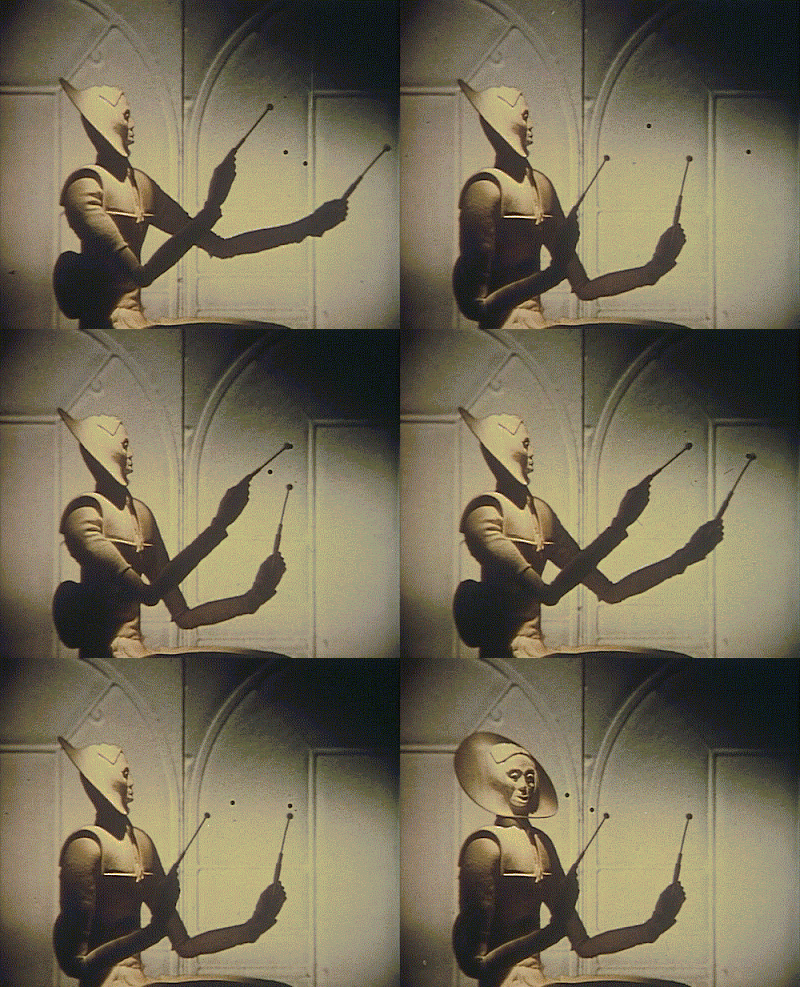
Chronopolis (1982)
Although I barely understand this avant garde children’s sci-fi animation, I have been completely transformed by it, viewing at least once a day for the last two weeks. (I know!) Piotr Kamler’s Chronopolis feels foreign and familiar; ancient and futuristic. It grapples with the monotony of permanence and the sense that what has always been may not always be. More importantly, it’s a breathtaking mediation on Brutalism with animation that almost looks like real material and a score by Luc Ferrari highlighting the genre of musique concrète. Nothing else by Kamler has hit me as hard, thus I return to it again and again. I have even begun using it as an anti-fashion reference, noting its lines, patterns and textures to include in my own presentation.
Read.
Robot by Adam Wiśniewski-Snerg
After watching Chronopolis, I began investigating anything else that seemed to capture Brutalist aesthetics and found I could just stick to Polish sci-fi. Robot predates Chronopolis by only a few of years (Kamler began working on it in ’77; Robot was published in ’73), but the captures the same disorienting feeling of not being sure of what one knows. While we never really get to the truth with Chronopolis (or I really don’t get it), we get somewhere interesting with Robot.
Checkout.
The Jewelry of Ed Wiener
I do not know whether modernist jeweler Ed Wiener got a chance to see Chronopolis, but I would imagine if he had, he might feel as though Kamler’s immortals either created or wore his pieces. Now, I know including a $3,000 silver cuff is ridiculous, but I think it exemplifies how aesthetic movements can inform our presentation instead of the fashion system.


